Resistance Fighters
Feinberg investigators are developing and testing new strategies to fight pancreatic cancer, with the hope of extending survival rates.
By Emily Ayshford | Photography by Gr8y Productions
“If you work in oncology you have to work on difficult problems, because cancer is an extremely difficult problem.” That’s according to Leonidas Platanias, MD, PhD, the director of the Robert H. Lurie Comprehensive Cancer Center of Northwestern University. And pancreatic cancer has proven to be one of the most difficult cancers to treat, Platanias said. Because it often displays no symptoms, spreads aggressively, and is notorious for shielding itself from the immune system, it’s just the sort of difficult problem that investigators at Northwestern University Feinberg School of Medicine are eager to take on.
“We’ve made advances in some areas of cancer treatment, but there are still huge challenges, and pancreatic cancer is definitely one of them,” noted Platanias, who is also the Jesse, Sara, Andrew, Abigail, Benjamin and Elizabeth Lurie Professor of Oncology. Through the development and testing of new pancreatic cancer drugs, testing new combinations of therapies, and working to understand potential new targets within tumors, however, Feinberg faculty are discovering how to extend survival time for patients, with the goal of making pancreatic cancer a chronic disease.
Improving survival outcomes
Pancreatic cancer is difficult to treat in part because its tumors are dense and fibrous, making them challenging to penetrate with therapy, and their microenvironment is extremely adept at shutting down the immune system and chemotherapy invaders. Very few treatments have shown efficacy, and the five-year survival rate for patients with stage 4 cancers remains about 3 percent.
“Patients know the implication of being diagnosed,” said Devalingam Mahalingam, MBBChBAO, PhD. “Once the cancer has spread, they know it is unlikely that they will live more than one year.”
Fifteen years ago, a team of Feinberg School of Medicine investigators discovered GSK-3 beta, a protein that plays a role in tumor growth and suppression of the immune system. Inhibiting this protein might have some anti-cancer properties, the team hypothesized.
They formed a biotech startup called Actuate Therapeutics and began developing a drug called elraglusib to target the protein. In 2017, clinical trials for the drug began at Northwestern. Mahalingam, who is also a professor of Medicine in the Division of Hematology and Oncology, led early trials that showed the drug could actually reverse resistance to chemotherapy.
“Patients seemed to be on treatment much longer, leading to an improved survival rate,” he said.
Mahalingam then led a phase 2 randomized clinical trial of the drug at Northwestern and at 60 sites across North America and Europe. In the trial, 233 patients with metastatic pancreatic cancer received the drug along-
side standard chemotherapy.
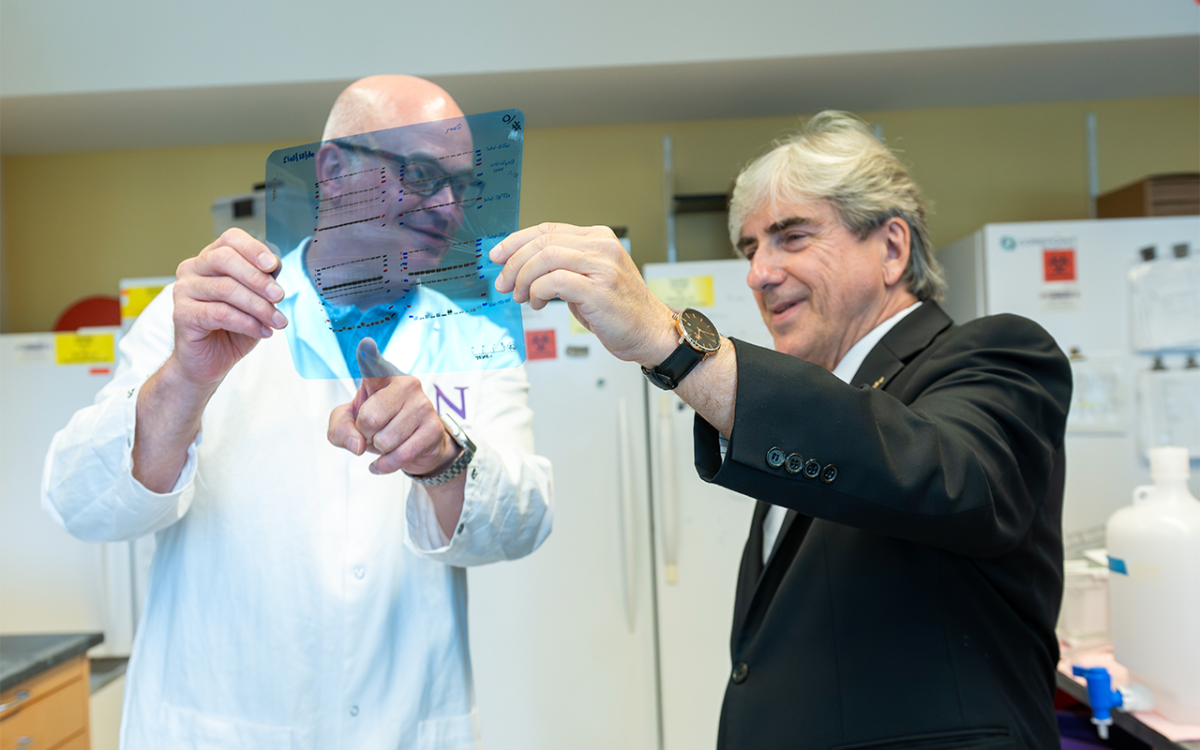
“We’ve made advances in some areas of cancer treatment, but there are still huge challenges, and pancreatic cancer is definitely one of them.”
Leonidas Platanias, MD, PhD
For Mary Mulcahy, MD, professor of Medicine in the Division of Hematology and Oncology, the Department of Radiology, and the Division of Organ Transplantation, who co-led the trial, enrolling her cancer patients in these sorts of trials provides benefits to both them and investigators.
“Patients know there are very few therapies for pancreatic cancer, and in the trial, they feel like participants in their care,” she explained. “It gives them a lot of purpose.”
The results from the trial, published in Nature Medicine this year, provided a ray of hope. Those who received the drug lived a median of 10.1 months, versus 7.2 months for those on chemotherapy alone. “Some patients were even alive two years later,” Mahalingam said. “It showed us that we were slowing down the growth of a very aggressive cancer.”
Though extra months might not seem like much, patients and their families were grateful to have that extra time, he remarked. “They were able to live fairly good lives and continue doing what they wanted to do.”
Patients who received the drug showed increases in the cancer-fighting immune cells within their tumors, suggesting that the drug might help ignite the immune system against the tumor.
Next, the team hopes to confirm the results with additional clinical trials. They also hope to combine the drug with immunotherapy to see if it improves survival even more. Ultimately, the team believes the drug could be used to treat other cancers as well.
“There is still a lot of work to be done, but it was really exciting to see a new drug, a new strategy that works,” Mulcahy said. “It’s a great breakthrough.”
Overcoming resistance to therapy
Another category of drugs that have given physicians and scientists hope recently are KRAS inhibitors: Mutations of the KRAS gene are found in more than 90 percent of pancreatic cancer cases, making it an attractive target for therapies.
The challenge, as with any cancer therapy, is resistance: Cancer cells adapt and become resistant to these inhibitors. “Cancer cells are like soldiers in war,” said Hidayatullah Munshi, MD, ’02 GME, the Ann Lurie Professor of Hematology and Oncology. “To survive, they are going to adapt, evade, and then escape. We’re working on strategies to block them at each of these steps.”
Munshi and his collaborators combined the KRAS inhibitor MRTX1133 with the FDA-approved drug venetoclax, commonly used to treat chronic lymphocytic leukemia and acute myeloid leukemia, and tested it in a mouse model of pancreatic cancer.
He and his team found that the KRAS inhibitor increased the levels of the BIM protein, which should promote cell death, but it did not cause the cancer cells to die. By adding venetoclax, the team resensitized the cells to the KRAS inhibitor, which then helped it to kill cancer cells. Their results were published in the journal Cancer Research.
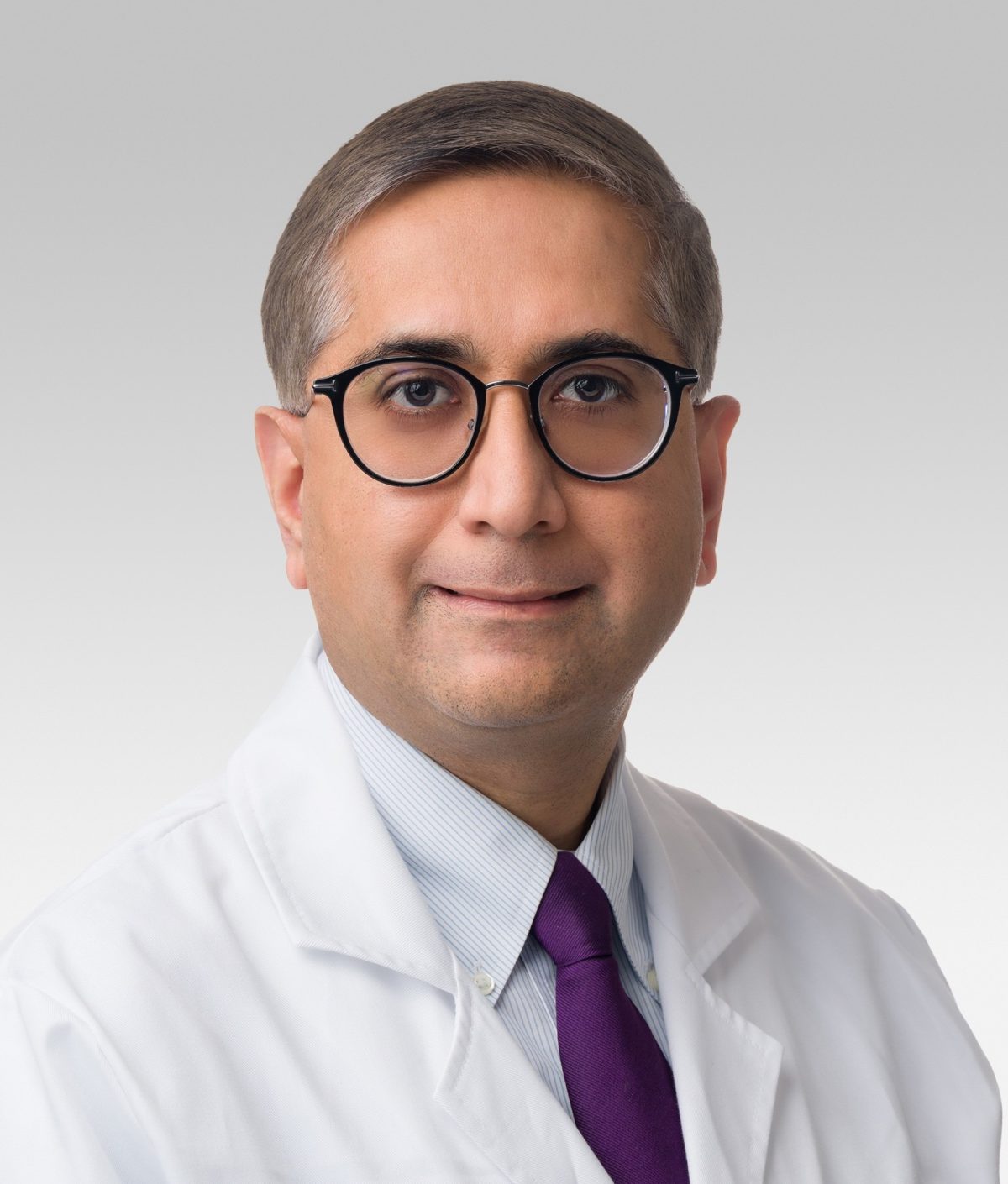
“Cancer cells are like soldiers in war. To survive, they are going to adapt, evade, and then escape. We’re working on strategies to block them at each of these steps.”
Hidayatullah Munshi, MD, ’02 GME
But pancreatic cancer ultimately finds a way to survive this dual treatment, too. As a follow-up, Munshi and his team then worked to rewire the chromatin of cells — the cellular “software program” that regulates gene expression. By using BET inhibitors, which block the ability of the cancer cell to change its gene expression and adapt against treatment, he and his team showed cancer cells can once again become more welcoming to therapies.
“Then you give them the KRAS inhibitor again, and the cancer cells will respond to the therapy,” he explained.
Now, his team is working on altering the tumor microenvironment, which is adept at blocking T-cells from attacking the tumor. Munshi and his team have studied the basic aspects of how cancer cells modify this environment to push out the T-cells. They found that another FDA-approved drug could help overcome this state.
“And when we use that with a KRAS inhibitor, we can see a therapeutic response once again,” he said. “By understanding the biology, we found vulnerabilities that we can now exploit to continue this never-ending battle with the cancer cells.”
Munshi’s ultimate goal is to turn pancreatic cancer into a chronic disease by continuing to find new ways to overcome cancer cells’ resistance. In working with Northwestern colleagues across disciplines — in physical sciences and epigenetics, for example — Munshi believes that the university has a competitive advantage.
“KRAS inhibitors are going to drastically change outcomes for patients,” he noted, “and if we can apply all that knowledge to tackling KRAS resistance, then we can work to give metastatic patients more and more time to live.”
A potential new therapeutic target
For many cancers, immunotherapies that harness the power of a patient’s own immune system have extended survival rates. Therapies called checkpoint inhibitors block proteins on immune cells from binding to tumors, allowing T-cells to find and destroy the cancer.
“But the big question with pancreatic cancer is why immunotherapies don’t work for it,” Platanias said.
An expert in interferons, the warning signals cells release in response to tumors, Platanias examined the pancreatic cancer tumor microenvironment and discovered that a group of proteins called Schlafen proteins were induced by signaling proteins called interferons.
That, in turn, led Platanias and his team to find that one of these proteins, called Schlafen 5, can control the immune response against tumors.
That makes it a potential target for therapies. While checkpoint inhibitors work by switching off proteins on the surface of cells, Schlafen 5 sits within the cancer cell. “It’s a hidden immune checkpoint,” Platanias explained. “It’s an intracellular immune checkpoint.”
When he and his team knocked out the protein in a mouse model of pancreatic cancer, the mice had a prolonged survival. Now, his team is working with collaborators across Northwestern to develop a molecule that could block Schlafen 5, with the ultimate goal of creating a new therapy for pancreatic and other hard-to-treat cancers.
“Feinberg has exceptionally strong basic science and clinical research programs, as well as fantastic collaborators in engineering and chemistry,” Platanias said. “That creates a synergy that allows us to target cancer in novel ways. It’s very hard to develop new drugs — you have to be persistent. But that’s what we are doing.”