Advances in Computational Genomics
Feinberg scientists advance the use of computational genomics to reveal meaningful DNA insights that improve and save lives.
By Cheryl Soohoo | Photography by Teresa Crawford
In 2001, uncovering the genetic blueprint of a single human genome cost about $95 million. Today, DNA sequencing runs a few hundred dollars or less, making it easier to use genomic data to enhance health, from pinpointing novel druggable targets to predicting and preventing disease. Growing to staggering proportions, the rise of “big data” in genomics has given way to the field of computational genomics — a subfield of bioinformatics and computational biology. Blending biology, computer science, statistics, and mathematics, this emerging discipline mines massive datasets of DNA, RNA, and protein sequences for answers to complex biological questions.
“Advances in experimental methods are generating overwhelming amounts of genomics data — more than any one investigator or lab can handle,” said Feng Yue, PhD, a globally recognized expert in computational biology and founding director of the Center for Cancer Genomics at the Robert H. Lurie Comprehensive Cancer Center of Northwestern University as well as director of the Center for Advanced Molecular Analysis at the Institute for Artificial Intelligence in Medicine. “Extracting relevant genes and pathways from this vast sea of information and turning findings into testable hypotheses depends on powerful computational tools and methods.”
Beyond novel research studies, the melding of advanced genomic sequencing with powerful computational analysis is now generating real-time insights that clinicians can act on for their patients. In cancer care, genomic profiling of tumors, for example, is accelerating the use of precision oncology — delivering more effective and less toxic cancer treatments. A key component critical to the future of cancer care, this personalized strategy tailors therapies to the unique genetic features of a patient or their tumor in ways that were once unimaginable.
We were among the earliest to conduct whole-genome sequencing and provide computational analyses of SARS-CoV-2 in Illinois. We tracked the highly transmissible virus for our hospital system and provided city- and state-wide metrics.
Egon Ozer, MD, PhD, ’08 GME
Yue’s lab employs sophisticated computational approaches, including AI and machine learning, to model genome function to understand how genetic mutations drive cancer. Yue’s expertise in 3D genome organization recently led to a landmark study published in Nature in December 2025 detailing how genome architecture can influence human biology and disease. Northwestern investigators — together with the 4D Nucleome Project — produced the most comprehensive maps to date of the genome’s three-dimensional structure across time and space, otherwise known as the 4th dimension. The findings revealed that rather than a twisting ladder of code, the human genome folds into loops and compartments within the cell nucleus. This folding can impact cell function, according to Yue, who is also the Duane and Susan Burnham Professor of Molecular Medicine.
“When genome folding goes wrong, gene regulation can be disrupted. Genes that should be silent may be turned on, while critical genes can be shut down, ultimately leading to disease,” Yue explained. This game-changing work has resulted in new computational tools to help predict genome folding simply from its DNA sequence and estimate how genetic variants may alter 3D genome architecture and, ultimately, overall human health.
Yue is among a growing number of faculty advancing computational know-how at Northwestern. Thanks to the university’s supercomputing capabilities and Feinberg’s Genomics Compute Cluster, investigators have access to key computational genomics resources required to drive breakthroughs across medicine.
Targeting neuroinflammation in Alzheimer’s disease
An estimated 7.4 million Americans age 65 and older currently live with Alzheimer’s disease. As the “graying” of the U.S. population increases, so do new diagnoses of this deadly form of dementia. Barring new preventive strategies or cures, the number of older adults with Alzheimer’s is projected to expand to 13.8 million by 2060, according to the Alzheimer’s Association.
Tackling this major public health concern, computational genomicist David Gate, PhD, assistant professor in the Ken and Ruth Davee Department of Neurology’s Division of Behavioral Neurology, leads Northwestern Medicine’s Abrams Research Center on Neurogenomics. Established in October 2024, the center uses artificial intelligence (AI) to reveal the genomic underpinnings of Alzheimer’s disease and accelerate development of more effective therapeutics. Focused on the immune system’s role in neurodegenerative disease, the Gate lab employs AI and computational genomics to analyze biosamples from clinical trial participants. The aim: to identify novel biomarkers or immunotherapeutic targets for the neurodegeneration seen in Alzheimer’s as well as Parkinson’s disease and ALS.
“Imagine the brain as a city with highways running through it,” said Gate, an early trailblazer in the use of computational genomics in the neurosciences. “Computational tools allow us to map the traffic jams, or inflammation, and the location of road crews, or immune cells. The construction sites, or pathology, reveal where blockages are occurring in the city, or the brain, so that we can help it run more smoothly.”
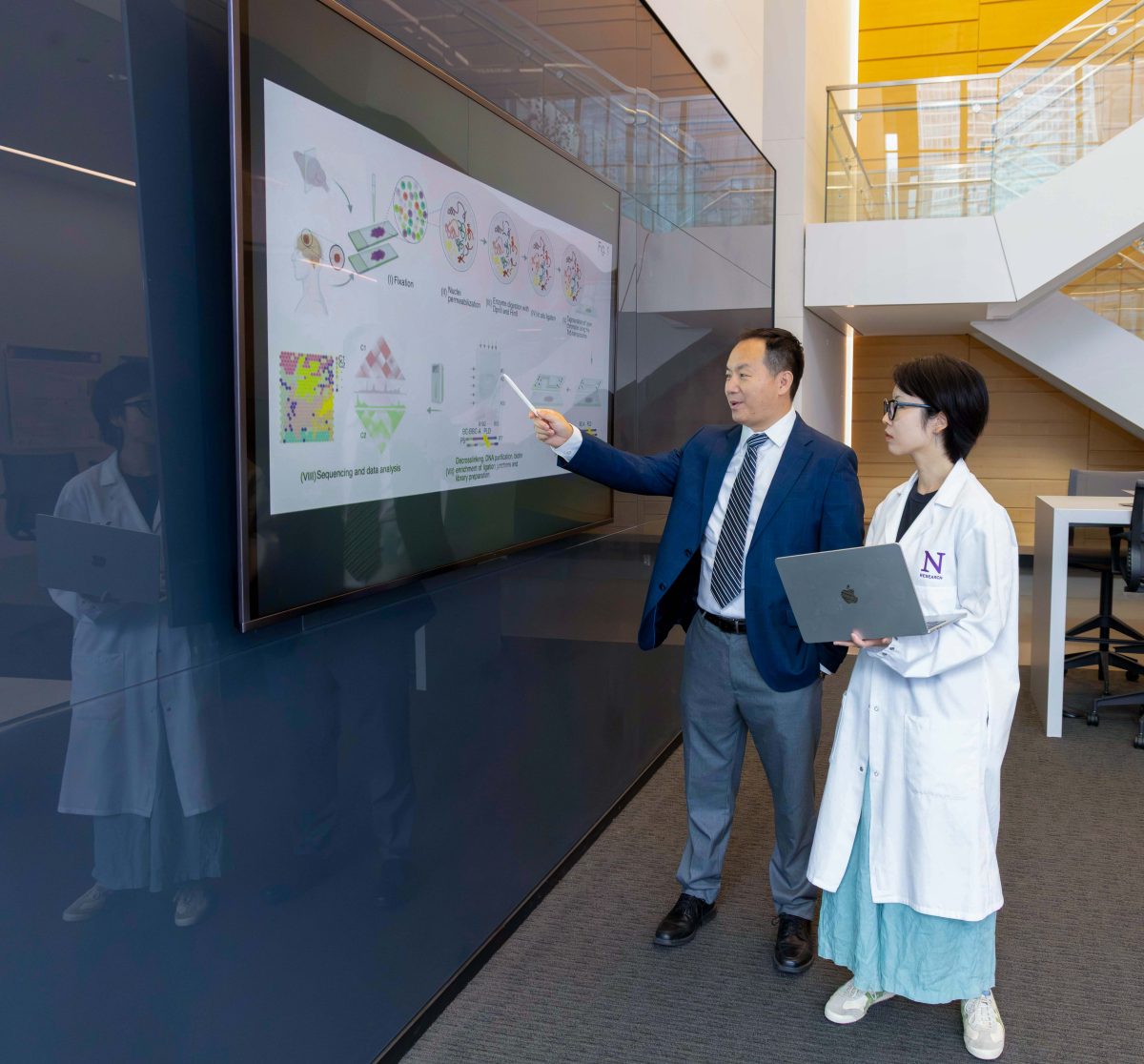
Through the center, Northwestern’s computational innovators and experimental biologists are creating novel computational methods. Gate and his colleagues published a paper in the May 2026 issue of Nature Genetics describing a new AI-driven spatial multiomics tool dubbed SpaMosaic. Designed to integrate often fragmented spatial datasets, the novel technology enables the construction of ultra-high-resolution atlases of tissues. For the neurosciences, this tool could improve mapping of brain development, neuroinflammation, and eventually disease states like Alzheimer’s or ALS, according to Gate.
Identifying novel RNA’S cancer role
In this age of AI, the ongoing evolution of computational genomics to reveal the genetic mechanisms of disease, such as cancer, is accelerating, according to bioinformatician Rendong Yang, PhD, associate professor of Urology. “We are currently undergoing a huge revolution!”
Yang’s research, with an emphasis on genomic technologies, has been especially prolific this year. In the January 2026 issue of Nature Communications, his team introduced a genomic language model, DeepChopper, for analyzing long-read direct RNA sequencing data. In March, the same journal also published the group’s discovery that a specific long non-coding RNA, called IGF1R-AS1, activates oncologic signaling pathways in prostate as well as lung cancer cells and fuels tumor progression.
Advances in experimental methods are generating overwhelming amounts of genomics data — more than any one investigator or lab can handle.
Feng Yue, PhD
Additionally, Yang co-authored an innovative brain tumor study with Shi-Yuan Cheng, PhD, professor in the Division of Neuro-Oncology, that appeared in the May edition of Nature Cell Biology. The scientists found that increased expression of a novel long-coding RNA drives cell growth in glioblastoma, the most aggressive and common primary malignant brain cancer in adults. This finding offers promise for better targeting tumor resistance for a condition that has a five-year survival rate of less than 7 percent, according to the National Brain Tumor Society.
Tracking life-threatening infectious diseases
During the pandemic, fast-evolving mutations of the SARS-CoV-2 virus that causes COVID-19 made headlines around the world. Genetic variations of this single-stranded RNA virus have the potential to increase infectiousness and/or severity. In 2021, the ongoing global health crisis spurred the launch of the Center for Pathogen Genomics and Microbial Evolution within the Robert J. Havey, MD Institute for Global Health. One of a few programs of its kind in the nation, the center offers specialized expertise in pathogen-specific sequence analysis and bioinformatics for developing and ongoing infectious disease threats.
“We were among the earliest to conduct whole-genome sequencing and provide computational analyses of SARS-CoV-2 in Illinois,” said Egon Ozer, MD, PhD, ’08 GME, founding director of the center and associate professor in the Division of Infectious Diseases. “We tracked the highly transmissible virus for our hospital system and provided city- and state-wide metrics.”
Genomic surveillance of microbial genes using tools like computational genomics helps to rapidly identify disease-causing viruses, bacteria, and other pathogens; flag concerns such as antibiotic drug resistance; and effectively diagnose and follow the trajectory of infections. While COVID-19 activity has lessened, the center continues to vigilantly monitor diseases with “pandemic potential” like influenza and respiratory syncytial virus (RSV)-related pneumonia or bronchiolitis to support a strong public health response, according to Ozer.
As artificial intelligence becomes more em- bedded in science, medicine, and society, human intelligence must keep pace, according to Feinberg scientists. People power remains essential to asking the right questions in genomic data analysis and to harnessing AI to elicit accurate, interpretable, and biologically meaningful information. The surge of genomics data has created a critical void to be filled by scientists skilled in the technological tools of modern biology. To train the next generation of experts, Feinberg recently added a computational biology and bioinformatics PhD track to the Walter S. and Lucienne Driskill Graduate Program in Life Sciences for the 2026 application cycle.
“Responding to the extraordinary call for a larger talent pool of individuals who can integrate computation with biology and medicine is critical,” noted Yue, who is spearheading the development of the initiative’s bioinformatics curricula. “Our new track will help meet this demand, further strengthen Feinberg’s computational educational and research community, and move the field of computational genomics forward.”