Home / Alumni News / Setting Spines Straight
Setting Spines Straight
Setting Spines Straight
Lawrence Lenke, ’86 MD, has devoted his career to fixing severe spinal deformities and setting new standards for how surgeons treat them.
By Christina Frank
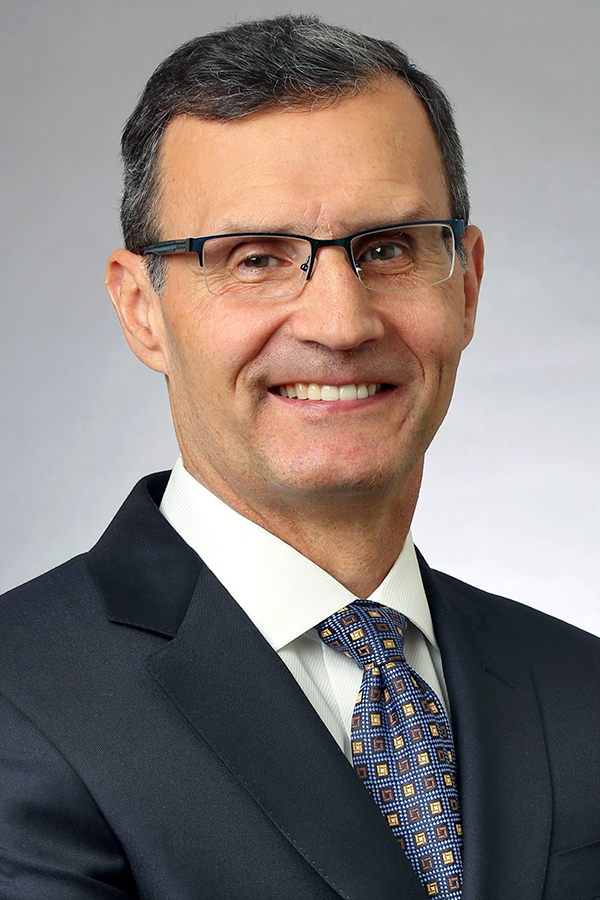
Over the past four decades, Lawrence Lenke, ’86 MD, has become one of the defining figures in spinal deformity surgery. Lenke is the co-director of Och Spine, surgeon-in-chief at the Daniel and Jane Och Spine Hospital, and chief of spinal deformity surgery in the department of orthopedic surgery at NewYorkPresbyterian/Columbia University Irving Medical Center. Among his many contributions to medicine, his development of the Lenke Classification System set the gold standard for identifying idiopathic adolescent scoliosis — a benchmark for the past 25 years.
Lenke grew up in a lower-middle-class suburb of Chicago. While neither of his parents had a college education, his mother’s job as a secretary for an orthopedic surgeon exposed him to medicine and orthopedics at a young age. “As far back as I can remember, I always wanted to be a doctor,” Lenke said.
During his undergraduate years at Notre Dame University, Lenke distinguished himself as a top premed student, earning the attention of a well-connected adviser who helped open doors for him at leading medical schools. After interviewing at Northwestern University Feinberg School of Medicine and the University of Chicago, Lenke, who is the winner of Feinberg’s 2026 Distinguished Medical Alumni Award, chose Feinberg because it seemed more clinically focused. He went on to pursue spinal surgery after being inspired by two top scoliosis surgeons at Northwestern, a decision that would ultimately define his career.
Spine care is becoming its own field. It’s complex and multidisciplinary, and we wanted to build something that reflects that.
Lawrence Lenke, MD
Lenke completed his residency at Washington University School of Medicine in St. Louis, where he remained for 30 years. When he began practicing at Shriner’s Children’s St. Louis Hospital, he was handed a list of over 100 children awaiting spinal deformity surgery. Most had scoliosis, an abnormal curvature of the spine that, in severe cases, can compress the internal organs; other patients had kyphosis, a condition in which the spine curves forward.
“I started with simpler cases and worked my way up,” Lenke explained. “I was doing surgery two to three times a week. In the first five to 10 years, I got tremendous experience. That’s really when everything snowballed.”
One case transformed his career: a 14-year-old girl from Moscow with one of the most severe scoliosis cases Lenke had ever seen. “The curvature was so extreme it was compressing her heart and lungs and restricting her ability to breathe. She was too sick to even operate on,” he said. She was placed in skeletal traction for several months to gradually stretch the spine until she was healthy enough to undergo surgery. She then had a two-stage procedure called a vertebral column resection (VCR), in which the affected vertebrae are surgically removed to allow the spine to be safely corrected and realigned. After the surgery, the girl, who had been severely hunched over, gained 13 inches in height and went on to become a model, wife, and mother.
“Someone who was literally going to die in her 20s without treatment ended up just doing fantastic,” Lenke noted. “I realized I could take care of even the most severe cases. After that, I restricted my practice to everything except spinal deformity.”
Lenke’s influence extended beyond the operating room when he developed a new system for classifying scoliosis; the existing framework lacked consistency. “We couldn’t even agree on how to classify cases,” he said. “So how could we figure out the best way to
treat them?”
The Lenke Classification System, published in 2001, organized adolescent idiopathic scoliosis into six curve types based on the location, severity, and flexibility of the spinal curvature, giving surgeons around the world a common tool for diagnosis and surgical planning. “It was a better way to communicate,” Lenke explained. “I didn’t realize at the time how important it would become.” The system has been used worldwide for identifying and treating adolescent idiopathic scoliosis.
Lenke was among the first surgeons to recognize the value of 3D-printed models in planning complex spinal procedures. By 2000, advanced imaging had already provided surgeons with CT scans they could rotate on a screen, but a physical model offered the ability to hold the deformity in your hands before making a single incision. “To actually hold a model of a patient’s deformed spine and understand the anatomy – that was a game changer,” Lenke said. “It makes surgery safer.”
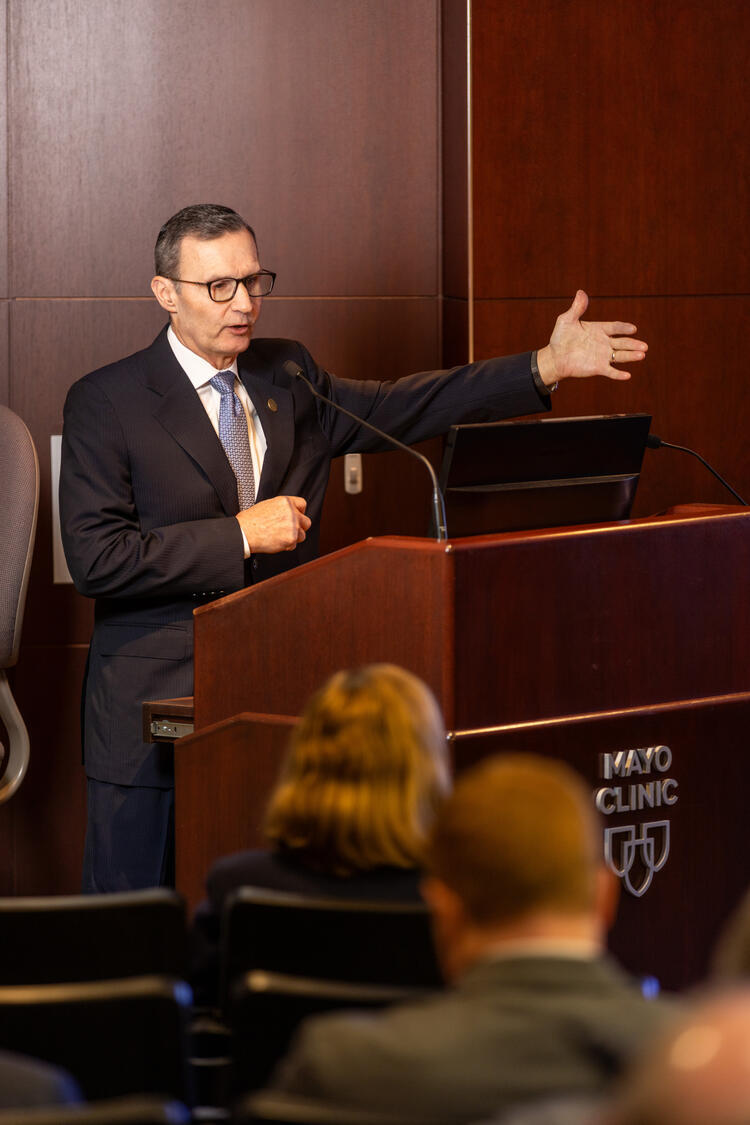
In 2015, Lenke joined NewYork-Presbyterian/Columbia University Irving Medical Center to help build a comprehensive spine program. He and his new colleagues created a “spine hospital within a hospital” dedicated to spine surgery, now one of the most advanced programs of its kind. “Spine care is becoming its own field,” Lenke proclaimed. “It’s complex and multidisciplinary, and we wanted to build something that reflects that.”
Lenke credits much of his professional philosophy to James Hill, ’70 MD, ’79 GME, an orthopedic surgeon who was his adviser and mentor during his years at Northwestern.
“He is just the most humble, honest person,” Lenke said. “And he taught me how to be a confident surgeon without being arrogant or cocky.”